

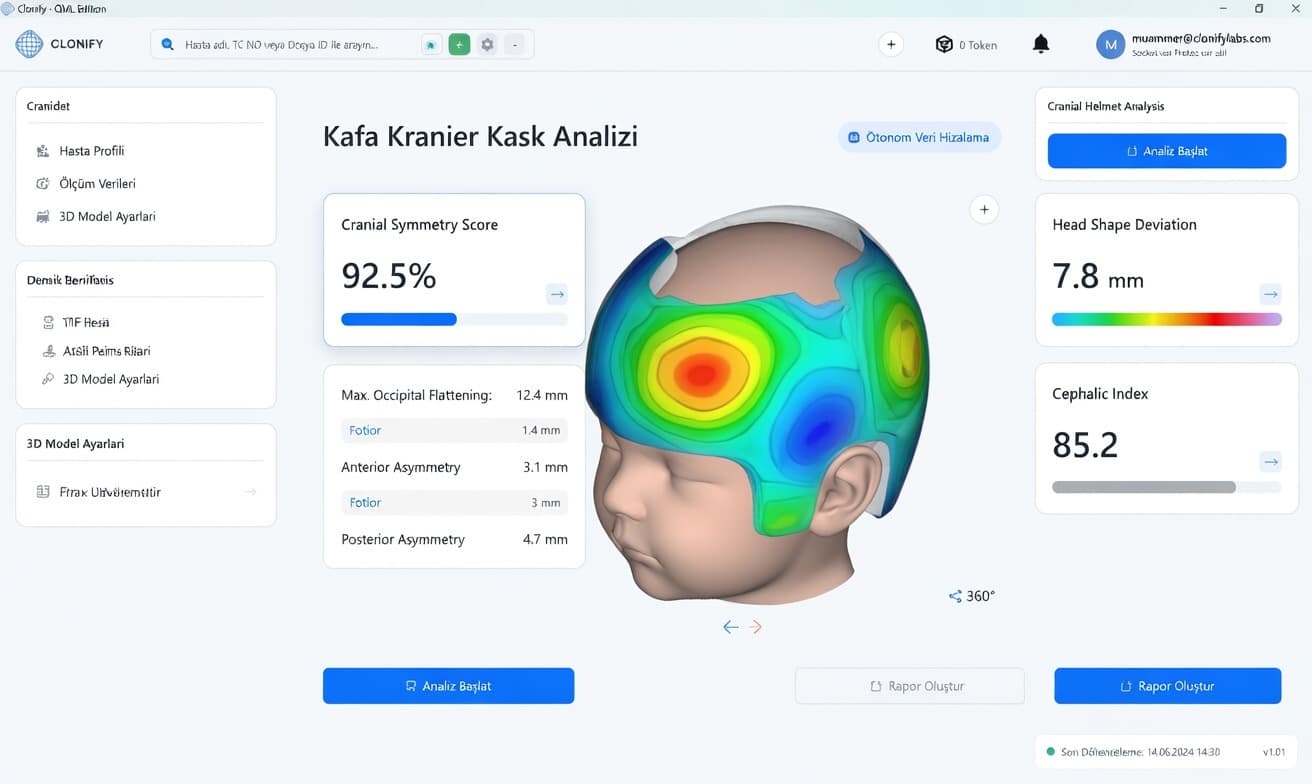
Cranial helmet therapy has a constraint that other orthotic fields do not: time cannot be rewound. The most effective window for plagiocephaly treatment is roughly months 4 to 8; the skull grows fast in that period, which is what makes redirection effective. When a helmet is delivered two weeks late, the growth potential of those two weeks is lost with them. In the helmet workflow, speed therefore has a direct effect on clinical outcome.
The traditional process goes like this: a stockinette is pulled over the infant's head, a plaster bandage impression is taken (no easy session with a restless baby), the cast dries, a positive model is poured, the model is corrected by hand, and the helmet is formed over that model. Each step takes days — usually two to three weeks in total. And a small deviation accumulates at every step: bandage pressure slightly deforms the head, the cast shrinks, hand correction varies with the craftsman's eye.
You can't manage what you can't measure
The treatment decision itself rests on measurement. Parameters such as the cranial vault asymmetry index and the cephalic ratio show whether treatment is needed and whether it is progressing. Manual caliper measurement, however, varies with the person measuring: two clinicians measuring the same infant can arrive at different values and different classifications. We run into this in the field again and again.
A digital scan records the entire head geometry — hundreds of thousands of points. The asymmetry map comes out automatically: which quadrant is flattened and by how much, where the apex has shifted, how many millimetres the ears are offset. When the same patient is scanned again a month later, the two scans are superimposed and you see concretely where the growth went. Showing parents two maps side by side instead of saying 'it's improving' visibly increases treatment adherence — we have experienced this in the field over and over.
On the design side, the alignment step comes to the fore. Registering a scan to the anatomical planes takes minutes even for the most experienced user when done manually — and it affects the result. Clonify proposes the alignment automatically; the clinician checks it and corrects it if needed. What matters is that every case uses the same reference: in a therapy that requires serial measurement, repeatability is worth even more than precision.
What we saw in the pilot clinics
Before releasing the helmet module we ran it in two clinics, on real cases, in parallel with the traditional process. The first thing that stood out was design time: the scan-plus-guided-design flow replacing the cast-mould-rework chain shortened that step markedly. Total staff time per device — measurement, design and fitting together — is still being measured under the 90-day protocol; we will not give that figure before the protocol ends. But the outcome clinicians cared about most was something else: how the helmet sat at the first fitting.
In manual production the first fitting is usually an 'adjustment session' — it pinches here, it gaps there, the helmet goes back to the workshop. For a parent making repeated trips to the clinic with their baby, every extra session is a real burden. The promise of the digital line is fewer of those sessions; we are measuring the first-fitting delivery rate under the protocol and will publish the result on the Evidence page.
Not everything ran smoothly from day one. In the first weeks scan quality depended on the team's hand skills; getting a clean scan of a moving baby takes practice. We recommend that clinics considering the transition set aside the first weeks for scan training and start with realistic expectations.
A few notes for families
If you notice a head-shape irregularity, your first stop is always your physician; a helmet is not needed in every case, and most mild cases resolve with repositioning. If a helmet has been recommended, do not hesitate to ask how your clinic takes its measurements. A clinic that tracks numbers and can show you a measurement report means you can follow the course of treatment together.
Clinics that want to see the helmet module on a real case can request a demo.
See Clonify with your own cases
Start with a free 30-minute demo.