

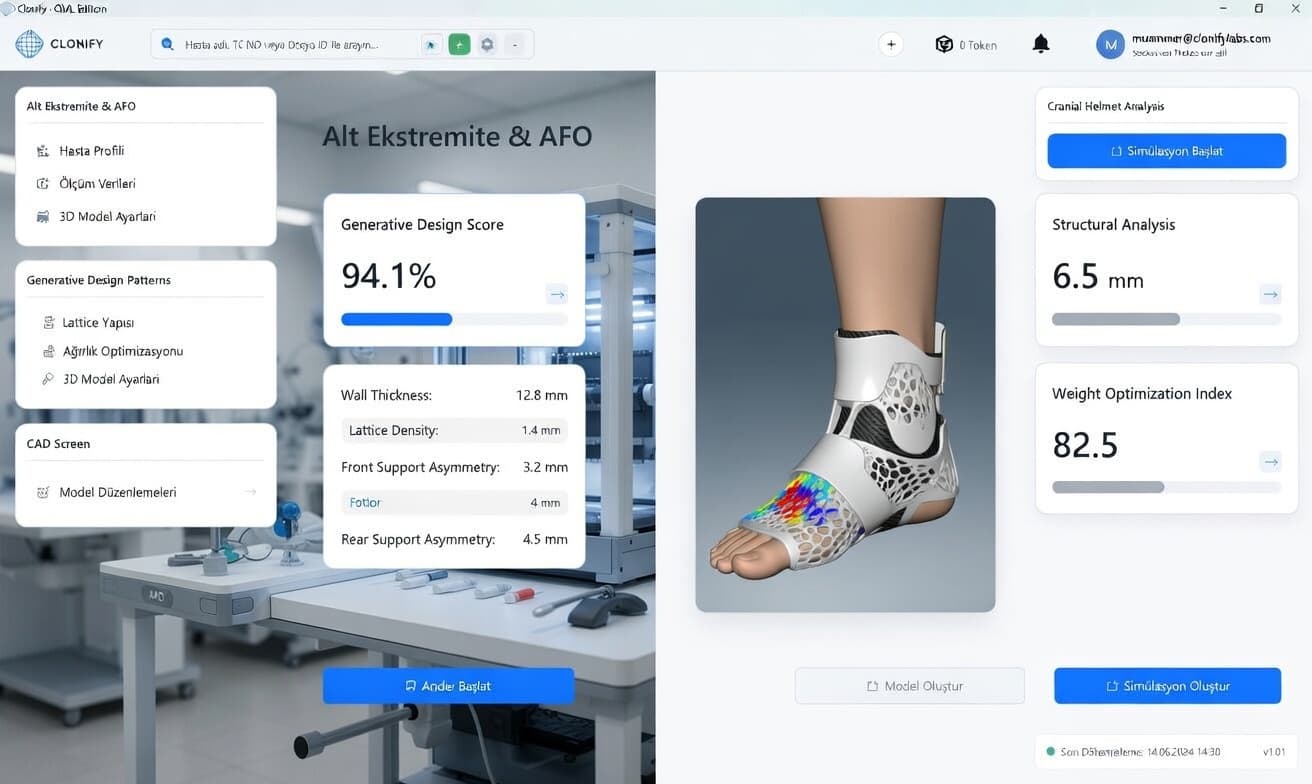
AFO is recommended as the starting point of a digital transition for good reason. Case volume is high in most clinics, the geometry is well defined, and the pain points of traditional production — the ordeal of the casting session, the handcrafted trim line, the hours spent at the grinder over an ill-fitting orthosis — are things everyone knows by heart. So the gains show quickly and team motivation arrives early.
Below is the four-week transition plan we settled on in our pilot clinics. Four weeks is an average; we have seen clinics go faster, and clinics stretch to six weeks. The AFO module is still in development. The framework below comes from our transition experience in pilot clinics; measured, AFO-specific results will not be published before the measurement protocol is complete.
Week 1: scanning only
There is no production target in the first week; the only job is for the team to learn to capture reliable scans. It sounds simple, but holding the foot in neutral position during an AFO scan is critical — and with a child who has spasticity, that is a two-person job. In the first days a share of the captures will be unusable — that is normal and part of the plan. By the end of the week the team can judge scan quality at capture time: which shadow causes trouble, which angle is missing.
The hidden gain of this week is psychological: the resistance of a technician who has worked with plaster for years — 'this can't be done with a tablet' — starts to crack at the first clean scan taken with their own hands. The way to speed this up is to have the first scans done by the most experienced — and usually most sceptical — technician. Convince the sceptic and the rest of the team follows.
Weeks 2-3: parallel production
In weeks two and three the same cases run down both lines: produced in plaster and on the digital line. Yes, workload rises for these two weeks — say so up front, because when it goes unsaid the team codes the transition as 'extra burden' and resistance grows. The point of parallel production is comparison: the two orthoses are placed side by side on the same patient, and fit, trim line, weight and patient feedback are recorded.
These comparisons are the most valuable moment of the transition, because the debate stops being abstract. 'Is digital any good' turns into 'look at the medial malleolus clearance on this patient.' A team that reaches the decision with its own eyes makes a far more durable transition than one ordered from above.
At the end of week three, test the revision flow too: make a deliberate change to one design — raise the trim line, alter the ankle stiffness — and reproduce it from the model. In manual production 'revision' means the grinder; in digital it means a parameter change and a new print. The team seeing that difference first-hand is the moment the transition becomes irreversible.
Week 4 and beyond: digital as the primary line
In week four the digital line becomes the primary flow; plaster stays in reserve for exceptional cases (do not expect to drop it entirely in the first month — a hybrid approach continues for a while in some complex deformities). This week's job is establishing rhythm: the scanning appointment calendar, overnight planning of the print queue, more frequent delivery sessions.
There is no published Clonify figure for labour savings or first-fit rate at the end of the first month — those metrics are being measured in pilot clinics under a 90-day protocol, and the results will be published on the evidence page with definitions fixed in writing before the protocol began. The targets we hold are public: scan-to-delivery ≤2 days, team training ≤8 hours, first unassisted device ≤5 business days. These are engineering targets we aim to validate; they are not commitments. And they hold with one caveat: all of them are built on scan training done properly in week one. Clinics that rush the transition and skip the first week pay it back in later months as scan-quality problems.
If you want to adapt this plan to your own case mix, we can go through the AFO flow in its current development state on a real case in a demo call.
See Clonify with your own cases
Start with a free 30-minute demo.