
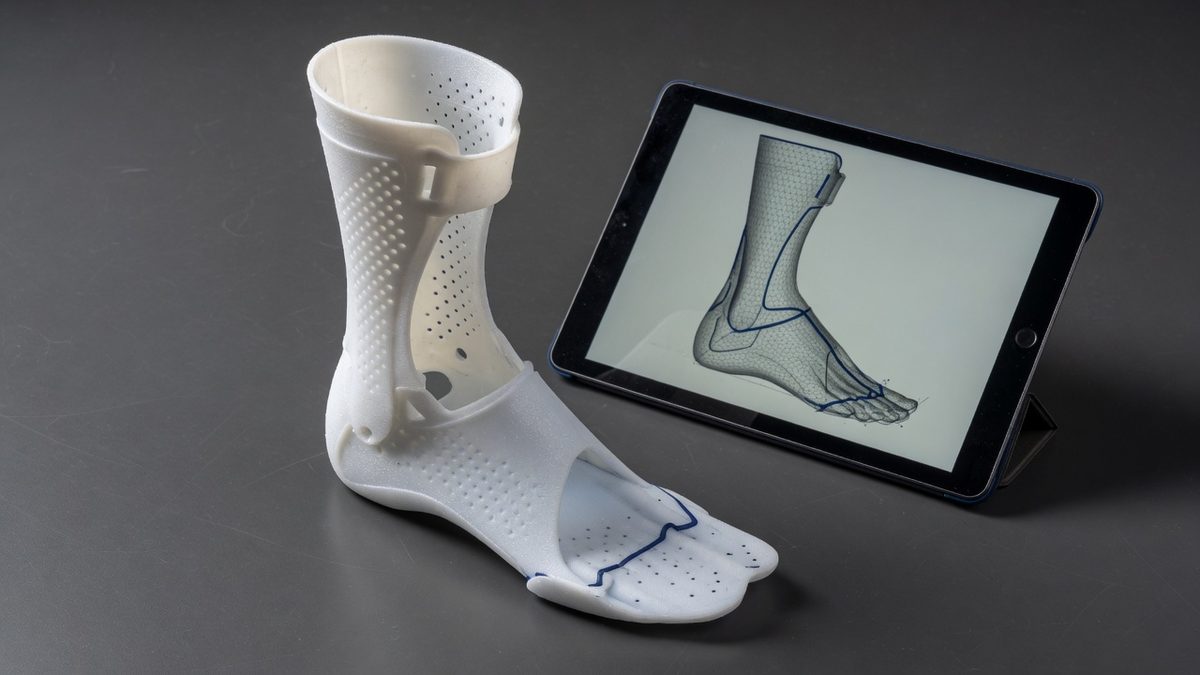
The AFO is one of the devices orthotic clinics make most often. Families, meanwhile, often meet the abbreviation for the first time on a prescription and ask the same questions: what does it do, how long is it worn, does it really make a difference?
This article summarises what an AFO is, which types exist, and what studies show in the two situations where it is used most: stroke and cerebral palsy.
What is an AFO?
AFO stands for ankle-foot orthosis. It consists of a shell that runs from the back or front of the calf down under the sole of the foot. It limits or guides ankle motion and holds the foot in the intended position.
Its effect isn't limited to the ankle. Because it controls the angle at which the foot meets the ground and the inclination of the shin, it also indirectly affects how the knee behaves while walking. That is why AFOs are also used to support the knee against excessive bending (crouch gait) or hyperextension.
Who is an AFO for?
The most common use is foot drop: when the muscles that lift the foot are weak, the toes catch the ground during the step. Foot drop can follow a stroke, peripheral nerve injuries and various neuromuscular conditions.
The second large group is children with cerebral palsy. Here an AFO is used to control the ankle position caused by spasticity, support heel-first contact and improve balance. Prescribing an AFO and choosing its type is a joint decision for the physician and the orthotist.
Types of AFO
A solid AFO allows very little ankle motion and gives the most stability. A hinged (articulated) AFO has a joint at the ankle and allows a set range of motion. A posterior leaf spring AFO lifts the foot during swing thanks to a flexible rear strut, and flexes during stance. A ground reaction AFO (GRAFO) uses an anterior shell to help push the knee back and is preferred in crouch gait.
The type is chosen according to muscle strength, the degree of spasticity, walking pattern and goal. Two patients with the same diagnosis may need different AFO types.
AFOs after stroke: what does the evidence say?
Tyson and Kent's 2013 meta-analysis pooled 13 randomised controlled trials (334 participants) of AFOs in people after stroke. The effect of AFOs on walking activity, walking impairment and weight distribution (balance) was significant and beneficial.
The effect on postural sway and timed mobility tests was not significant, and functional balance results were mixed. In short, AFOs support walking after stroke, but don't make a difference on every balance measure.
AFOs in cerebral palsy: what does the evidence say?
A systematic review published in 2026 collected 15 studies (390 children) on how AFOs affect balance and postural control in children with cerebral palsy. Certainty of evidence was very low for static and dynamic balance. Ground-reaction AFOs consistently gave better static stability than solid AFOs; hinged AFOs had inconsistent effects on dynamic balance. The authors highlight individual tuning of the AFO together with the footwear as one of the most decisive factors.
In a retrospective study published the same year, 66 children with cerebral palsy underwent 3D gait analysis with and without AFOs. With the AFO, the ankle showed about 10 degrees less plantarflexion in swing and at initial contact, meaning less toe drop. Changes in walking speed and the energy cost of walking, however, were not clinically significant.
Read together, these two studies show that AFOs reliably correct ankle position, but that this doesn't translate into faster or less tiring walking in every child. That is why type selection and individual tuning matter so much.
Sources
- Gasavi Nezhad Z, Vafayi AR, Arazpour M. The Effect of Ankle-Foot Orthoses and Their Characteristics on Balance, and Postural Control in Children With Cerebral Palsy: A Systematic Review. Health Sci Rep. 2026;9(6):e72613. doi:10.1002/hsr2.72613
- Goihl T, Rusaw DF, Brændvik SM, Roeleveld K. The Utilization of a Gait Pattern Classification System to Investigate the Effects of Ankle-Foot Orthoses on Gait in Children with Cerebral Palsy. Children. 2026;13(5):594. doi:10.3390/children13050594
How is an AFO made?
In the traditional method a plaster negative is taken of the leg, a positive model is cast and rectified, and thermoplastic is formed over it. In the digital method a 3D scan replaces plaster; design happens on a computer and the orthosis is produced on a 3D printer or over a digitally produced mould.
Clonify's AFO module is still in development and being validated in pilot clinics; it is not on sale. For clinics planning the move from plaster to digital, we describe a step-by-step transition plan in a separate article.
Frequently asked questions
What is an AFO?
An AFO (ankle-foot orthosis) is a brace with a shell running from the calf to the sole of the foot. It limits or guides ankle motion, holds the foot in the intended position and indirectly affects how the knee behaves during walking.
What is an AFO used for, and who needs one?
It is most often used for foot drop (after stroke, peripheral nerve injury and neuromuscular conditions) and in children with cerebral palsy, to control ankle position and support walking and balance. The type is chosen by the physician and orthotist.
What types of AFO are there?
The main types are the solid AFO, hinged AFO, posterior leaf spring AFO and ground reaction AFO (GRAFO). A solid AFO gives the most stability, hinged and leaf-spring types allow some motion, and a GRAFO is used to support the knee in crouch gait.
Does an AFO improve walking?
In a meta-analysis of 13 randomised trials after stroke, AFOs significantly improved walking activity and walking impairment. In 66 children with cerebral palsy, AFOs improved ankle kinematics, but changes in walking speed and energy cost were not clinically significant.
See Clonify with your own cases
Start with a free 30-minute demo.