
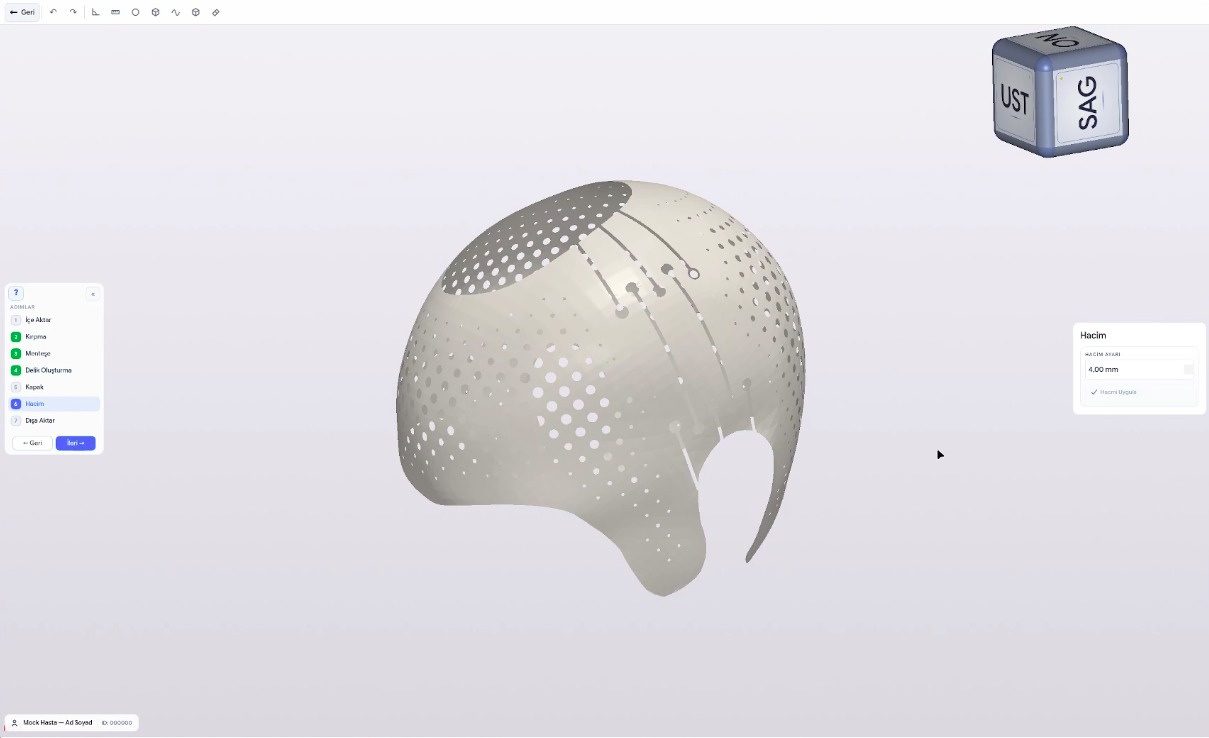
What parents usually notice first is a flat spot at the back of the head once the hair thins, or a baby whose head always turns the same way. Then the same questions go into a search engine: is this normal, will it go away, does my baby need a helmet?
This article answers those questions using the most widely cited guidelines on plagiocephaly and studies published in recent years. It doesn't replace an examination of your baby, but it clarifies which questions to bring to it.
What is plagiocephaly?
Plagiocephaly is an asymmetric flattening of the skull. The most common type is positional (deformational) plagiocephaly: when a baby's head rests on the same spot for long periods, the fast-growing, still-soft skull flattens there. When the back of the head flattens evenly on both sides, it is called brachycephaly.
The American Academy of Pediatrics (AAP) 2011 report describes positional skull deformities as generally benign, reversible conditions that don't require surgery. Distinguishing them from craniosynostosis matters: in craniosynostosis one of the skull sutures closes early, which can cause progressive deformity and neurological problems. That distinction is made by the examining physician.
Why is it so common?
From the 1990s, parents were advised to put babies to sleep on their backs, and this was associated with a dramatic fall in sudden infant death syndrome. Over the same period, cases of one-sided flattening at the back of the head increased. The AAP is explicit that healthy infants should still be placed on their backs to sleep despite this rise.
A national registry study from Finland, published in 2026, puts numbers on the trend: the prevalence of diagnosed plagiocephaly and brachycephaly rose from 1.7 per 100,000 live births in 1987 to 136 in 2010, with the steepest rise after 2000, when back-sleeping advice was formalised. Because the registry only captures diagnosed cases, the true frequency is higher.
A 2024 meta-analysis (19 studies, 14,808 participants) examined factors associated with plagiocephaly. Among the strongest were a preference for turning the head to one side (OR 4.75), reduced tummy time (OR 3.51), sleeping position (OR 3.12), bottle-only feeding (OR 4.65) and male sex (OR 1.51). These are associations from observational studies; none is a cause on its own.
Sources
- Vuola P et al. Prevalence and Temporal Trends of Deformational Plagiocephaly and Brachycephaly in Finland: A Population-Based Register Study. J Craniofac Surg. 2026. doi:10.1097/SCS.0000000000012892
- Hillyar CRT et al. Assessing the Evidence for Nonobstetric Risk Factors for Deformational Plagiocephaly: Systematic Review and Meta-Analysis. Interact J Med Res. 2024;13:e55695. doi:10.2196/55695
What are the signs?
In positional plagiocephaly the head looks like a parallelogram from above: one side of the back of the head flattens, and the ear and forehead on that side may shift forward. In brachycephaly the back of the head flattens on both sides and the head looks wide and short.
A baby who always turns the head to the same side is another sign to watch. It can be linked to tight neck muscles (congenital muscular torticollis), which need to be assessed separately as part of treatment.
Visual assessment during the examination is the first step. Follow-up needs measurement: skull asymmetry is expressed as CVAI and head proportions as the cephalic index. Repeating the measurement with the same method shows whether the shape is actually improving.
How is plagiocephaly treated?
The 2016 guideline from the Congress of Neurological Surgeons (CNS) looked at each treatment option separately. Repositioning education (guiding the baby into different positions while awake, more tummy time, drawing attention toward the non-flat side) gives some correction in virtually all infants. A structured physiotherapy programme was found to be more effective than repositioning education.
On positioning pillows the guideline is clear: in a randomised trial, adding a positioning device did no better than education alone. Because of the AAP's warning against soft positioning pillows in the sleep environment, the guideline recommends physiotherapy over any positioning device.
For helmets, the same guideline reviewed 15 studies (one randomised controlled trial). Its conclusion: a fairly substantial body of non-randomised evidence shows that head shape improves faster and more with a helmet than with conservative treatment, especially when the deformity is severe and the helmet is used during the appropriate period of infancy. Exactly which measurement value and which age window should trigger a helmet remains unresolved, according to the guideline.
Sources
- Klimo P et al. CNS Systematic Review and Evidence-Based Guideline on the Management of Patients With Positional Plagiocephaly: The Role of Repositioning. Neurosurgery. 2016;79(5):E627-E629. doi:10.1227/NEU.0000000000001428
- Tamber MS et al. CNS Systematic Review and Evidence-Based Guideline on the Role of Cranial Molding Orthosis (Helmet) Therapy for Patients With Positional Plagiocephaly. Neurosurgery. 2016;79(5):E632-E633. doi:10.1227/NEU.0000000000001430
Practical notes for parents
Don't change back sleeping; changes happen while the baby is awake. Supervised tummy time, switching sides when feeding and carrying, and moving the cot or toys so the baby turns toward the non-flat side are the commonly recommended measures.
If the head always turns the same way, or you see no improvement over a few weeks, talk to your paediatrician rather than waiting. When assessment happens early, the time window for physiotherapy and, if needed, a helmet is wider. For babies born preterm, that window is calculated from corrected age.
Frequently asked questions
What is plagiocephaly?
Plagiocephaly is an asymmetric flattening of a baby's skull. The most common, positional type develops when the head rests on the same spot for long periods; according to the AAP it is generally benign and reversible and does not require surgery. A physician distinguishes it from craniosynostosis, in which skull sutures close early.
What are the signs of plagiocephaly?
Typical signs are a parallelogram-shaped head seen from above, flattening on one side of the back of the head, the ear and forehead on that side shifting forward, and a baby who always turns the head the same way. Flattening across the whole back of the head suggests brachycephaly.
Does plagiocephaly go away on its own?
According to the 2016 CNS guideline, repositioning education gives some correction in virtually all infants, and a physiotherapy programme is more effective. In severe deformity, a helmet corrects faster and more. Whether improvement is sufficient should be tracked with repeated measurement using the same method.
Should I use a plagiocephaly pillow?
In the CNS guideline, adding a positioning device did no better than repositioning education alone. Because of the AAP's warning against soft positioning pillows in the sleep environment, the guideline recommends physiotherapy instead of positioning devices.
Does putting a baby to sleep on the side or stomach prevent plagiocephaly?
Changing sleep position is not recommended. Back sleeping is associated with the large fall in sudden infant death, and the AAP continues to recommend placing healthy infants on their backs. Prevention happens while the baby is awake: supervised tummy time and varied positioning.
See Clonify with your own cases
Start with a free 30-minute demo.