
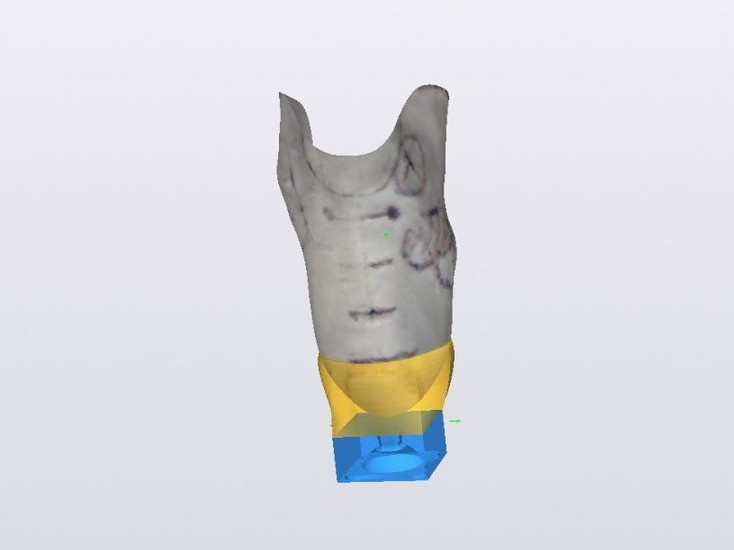
The most expensive part of a prosthesis is often the foot or knee, but whether the prosthesis gets used is usually decided by the socket. It is the only contact surface between the residual limb and the prosthesis; body weight, the forces of each step and suspension all pass through it.
That's why 'which socket?' is one of the questions clinics and patients ask most. This article summarises the common socket types and what the evidence says about each, including where that evidence is weak.
Below-knee socket types: PTB and TSB
A PTB (patellar tendon bearing) socket directs load to areas that tolerate it, especially the patellar tendon, while relieving sensitive areas such as the fibular head and tibial crest. For a long time it was the standard below-knee design.
A TSB (total surface bearing) socket aims to distribute load as evenly as possible over the entire residual limb surface. It is usually used with a liner and requires a closer, total-contact fit between limb and socket.
Safari and Meier's two-part systematic review, published in 2015, screened 1,863 records and included 35 studies. According to the part on qualitative outcomes, TSB sockets were associated with higher activity levels and satisfaction than PTB sockets in active users, people with traumatic amputation and younger users. That doesn't make TSB better for everyone: the finding concerns specific user groups.
Vacuum and hydrostatic sockets
In vacuum-assisted sockets a pump draws air out between liner and socket to create negative pressure. The aim is to keep the connection stable despite residual limb volume changing through the day. Hydrostatic sockets shape the limb under pressure, aiming to transfer load in a fluid-like distribution.
The review's part on quantitative outcomes (27 studies) reports favourable trends for vacuum-assisted sockets in gait symmetry, volume control and residual limb health compared with other designs, and suggests hydrostatic sockets may reduce inconsistent fittings. However, the qualitative part says evidence on outcomes such as satisfaction is inadequate for vacuum and hydrostatic sockets.
The review highlights another gap: what counts as a clinically meaningful change in socket fit, and safe and comfortable pressure thresholds under different conditions, have not yet been established systematically. The review dates from 2015; vacuum systems have spread since then, but comparative evidence hasn't grown at the same pace.
Above-knee (transfemoral) socket types
In above-knee amputation, socket types are mainly distinguished by how they relate to the sitting bone (ischium): the quadrilateral socket, the ischial containment (IC) socket and the subischial socket, which stays below the ischium. Anatomical designs such as MAS also belong to this family.
A systematic review published in 2026 found 7 randomised or controlled clinical trials comparing these types. The subischial socket showed a difference in comfort compared with IC (one study); there was no difference in quality of life or mobility. The authors rate the certainty of evidence as 'very low'.
Which socket for whom? The limits of the evidence
The honest conclusion from these reviews is that no socket type is best for everyone. The choice depends on limb shape, soft-tissue condition, daily volume change, activity level and the person's own preference. Most studies are small and use different measurement methods, which makes results hard to compare.
That uncertainty makes record-keeping even more important. If it isn't written down how much material was removed from which area in which socket, and why each revision was made, the next socket can't build on the last one. In Clonify's socket module, regional load and relief areas for transtibial and transfemoral designs are edited on screen, every change is stored as a separate version, and the production file is released only after clinician approval.
Frequently asked questions
What are the types of prosthetic sockets?
For below-knee (transtibial) prostheses, the most common types are PTB (patellar tendon bearing), TSB (total surface bearing), vacuum-assisted and hydrostatic sockets. For above-knee (transfemoral) prostheses, quadrilateral, ischial containment (IC) and subischial sockets are used.
What is the difference between PTB and TSB sockets?
A PTB socket concentrates load on tolerant areas such as the patellar tendon and relieves sensitive areas. A TSB socket aims to spread load over the whole residual limb surface and is usually used with a liner. According to a 2015 systematic review, TSB is associated with higher activity and satisfaction in active users, those with traumatic amputation and younger users.
Is a vacuum prosthetic socket better?
In a systematic review, vacuum-assisted sockets showed favourable trends in gait symmetry, volume control and residual limb health. But evidence on outcomes like satisfaction is inadequate and comparative studies are few; it can't be said to be better for every user.
Which socket is best for an above-knee prosthesis?
In a 2026 systematic review, the subischial socket showed a comfort difference compared with the ischial containment socket, with no difference in quality of life or mobility. The certainty of evidence is very low; the choice depends on the user.
See Clonify with your own cases
Start with a free 30-minute demo.