
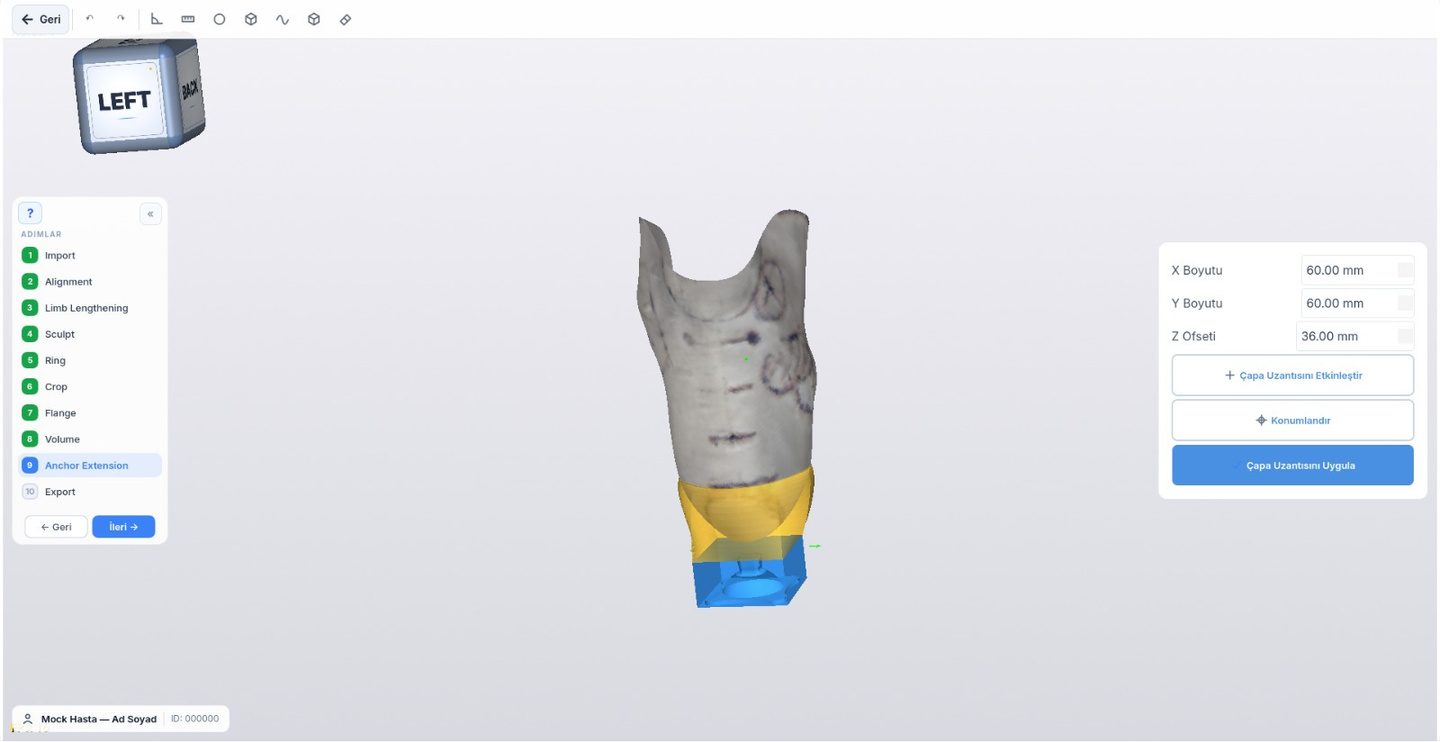
Over the last two years, sessions titled 'AI socket design' have multiplied at O&P meetings. The underlying question is old: can an algorithm learn the rectification an experienced prosthetist applies to a plaster positive, where to remove material and where to relieve?
This year, for the first time, a study answered that question with data collected outside the lab, from people actually wearing the prostheses. It is worth reading. It also says something narrower than the story told in software demos, so let's go through the numbers one by one.
What was done in the Sierra Leone study?
The study appeared in Archives of Physical Medicine and Rehabilitation (van der Stelt et al., 2026). At the 3D lab of Masanga Teaching Hospital in rural Sierra Leone, 34 people with a transtibial amputation and no functional prosthesis were enrolled. Sockets were produced by local staff with limited prosthetic experience, using software built on an algorithm trained on expert prosthetists' rectification data.
Twenty-seven people completed the ten-week follow-up. Activity sensors confirmed that all of them used the prosthesis. Median wear time was 9.3 hours a day; 39% of a median 3,978 daily steps were taken with the prosthesis. The patient-reported lower-extremity function score (OPUS, 0–60) rose from 45 to 52, and disease-specific quality of life (0–36) from 25 to 31. Generic quality-of-life measures (EQ-5D-3L and VAS) did not change significantly. 56% of participants reached the activity goal they had set themselves.
How should these numbers be read?
First, there is no comparison group. Participants had no functional prosthesis at baseline. The measured change is therefore the move from no prosthesis to a prosthesis, not the difference between an AI socket and an expert one. The design tells us nothing about whether the algorithm matches an experienced prosthetist.
Second, 7 of 34 participants were lost to follow-up, roughly one in five. We don't know whether they left because the socket didn't work for them or because travel was hard; those two explanations pull the result in very different directions.
Third, ten weeks is short. In new amputees, residual limb volume changes markedly in the first months, and some fit problems only surface during that period.
None of this makes the study worthless. The authors' own conclusion is modest: easy-to-use software and AI can support socket design where access to skilled prosthetists is limited. That is true and it matters. 'AI is replacing the prosthetist' does not follow from it.
How broad is the evidence for 3D-printed prostheses?
An AI-designed socket is usually 3D printed, which raises a second question: how well do we know the clinical outcomes of 3D-printed prostheses?
A scoping review published in 2026 in the Canadian Prosthetics & Orthotics Journal (Bhatla et al.) screened 1,396 records and included 42 studies reporting clinical outcomes. Thirty-one of them (73.8%) were case reports or case series; there were no randomised controlled trials. Thirty-two studies concerned upper-limb devices and ten transtibial devices. Fused deposition modelling was the most common method (76.2%).
In lower-limb studies, gait measures and patient-reported outcomes were generally comparable between 3D-printed and conventionally made devices. In the review's own words, the evidence base remains limited, and larger comparative studies with longer follow-up are needed.
What does the algorithm actually learn?
In a transtibial socket, rectification means directing load to tolerant areas (the patellar tendon, for example) and relieving sensitive ones (fibular head, tibial crest, distal end). A model trained on expert data learns the average pattern of those interventions across many limbs.
The trouble is that patients aren't average. Neuromas, grafted skin, adherent scars, prominent bony edges or volume that fluctuates through the day are all under-represented in training data. In those cases the algorithm's proposal can be a good starting point, but the final say belongs to the person who examined the limb by hand.
Our own design choices rest on this. In Clonify's socket module the regional load and relief map is edited on screen, every change is saved as a separate version, and the production file is released only after the clinician approves the form. Repetitive work such as measurement, alignment and record-keeping belongs to software. Where the pressure goes should be decided by the person who saw the patient.
Five questions to ask before buying an 'AI socket' tool
1) What data was the model trained on? How many prosthetists, how many limbs, which socket types? A model trained on transtibial data won't do the same job on a transfemoral case.
2) Can I change the proposal region by region, and are those changes recorded? A form that comes out of a black box and can't be edited is not usable in a clinic.
3) Is the output in an open format? Without an STL or similar file you lose the freedom to change printer, CNC or manufacturing partner.
4) What clinical data validated it? A lab comparison or patient follow-up? How many weeks, and how many people dropped out?
5) What happens to my past cases when the algorithm changes in the next release? If the same input produces a different form six months later, revision decisions become impossible to trace.
Frequently asked questions
Can AI design a prosthetic leg socket?
In a 2026 cohort study of 34 transtibial amputees in Sierra Leone, sockets produced with AI-assisted software were worn a median of 9.3 hours a day at week 10, and function scores improved. However, there was no comparison with sockets made by expert prosthetists and follow-up was short; there is no evidence supporting use without clinician oversight.
Will AI replace prosthetists?
The current evidence doesn't show that. Published algorithms are trained on expert prosthetists' rectification data, so expertise remains the model's input. The strongest use case is supporting design where access to specialists is limited.
Are 3D-printed prosthetic sockets as good as conventional ones?
According to a 2026 scoping review, gait and patient-reported outcomes in lower-limb studies were generally comparable. But 73.8% of the 42 studies reviewed were case reports or series and none was a randomised controlled trial, so it is too early for a firm verdict.
See Clonify with your own cases
Start with a free 30-minute demo.