
One of the questions we hear most often from clinics is: 'Can we start with a phone instead of paying for a scanner?' It's a fair question. The phone is already in your pocket, photogrammetry apps are free or cheap, and handheld scanners are still a real investment.
This year three studies looked at that question from different angles. Read together, the answer isn't 'yes' or 'no' but 'it depends on what you're scanning'. The details are as useful as the conclusion.
On a plaster cast: nearly as good as the reference scanner
Ellis and colleagues (Biomedical Engineering Online, 2026) scanned 12 casts covering upper limb, lower limb and AFO, both with a phone and with a clinical-grade structured-light scanner (EinScan H2). The reference scanner's own error was 0.21% in volume and 0.35 mm in dimensions.
Against that reference, smartphone photogrammetry gave a volumetric error of 0.89 ± 0.68%, a dimensional error of 0.89 ± 0.51 mm and a mean surface deviation of 0.24 mm. Agreement between operators was near-perfect (ICC ≥ 0.9997).
The usability numbers are less talked about but matter: a phone capture took about 62 photos and 88 seconds, then roughly 12 minutes of cloud processing. The reference scanner captured in 34 seconds and processed in 85 seconds on a desktop. Even so, users rated the phone as more usable (System Usability Scale 79 versus 58).
On a static phantom: video beats photos
De Waele and colleagues (Sensors, 2026) took it a step further and built an automated pipeline with no manual steps: an open-source workflow that picks suitable frames, removes the background with deep learning and fixes scale with ArUco markers. They tested accuracy on four 3D-printed residual limb phantoms against CT-derived meshes.
With smartphone video and a full-frame camera, surface accuracy was sub-millimetre and volume and circumference errors stayed within ±1%. Individual smartphone photos showed larger deviations and less stability. Capture took under five minutes, but full reconstruction took about an hour and a half.
On a living limb: the picture changes
Cullen and colleagues (Journal of Medical Engineering & Technology, 2025) tested a phone technique designed for remote, at-home scanning directly on transtibial amputees, again comparing against an EinScan H2.
On static targets the method exceeded 95% volumetric accuracy. On real amputees, measured volumes came out 63.4% larger. The authors concluded the method was not accurate enough for clinical use as it stands, while noting that accuracy improved in amputee-surrogate trials and that the approach is worth developing.
The difference isn't the camera, it's motion
Put the three studies side by side and the common thread is clear. A plaster cast or printed phantom doesn't move. A living limb moves constantly: with breathing, muscle tone and the small corrections people make to keep their balance. Because photogrammetry spreads dozens of frames over a minute and a half, all of that motion ends up in the model. A structured-light scanner finishes the same job in far less time.
Ellis's team points at the same thing in their conclusion: acceptable capture-time thresholds and effective stabilisation strategies on live limbs need to be established in multi-site studies. The same problem is sharper in cranial scanning: keeping an infant still for a minute and a half is often impossible, so fast capture in cranial scanning is a matter of accuracy, not comfort.
What can a clinic do today?
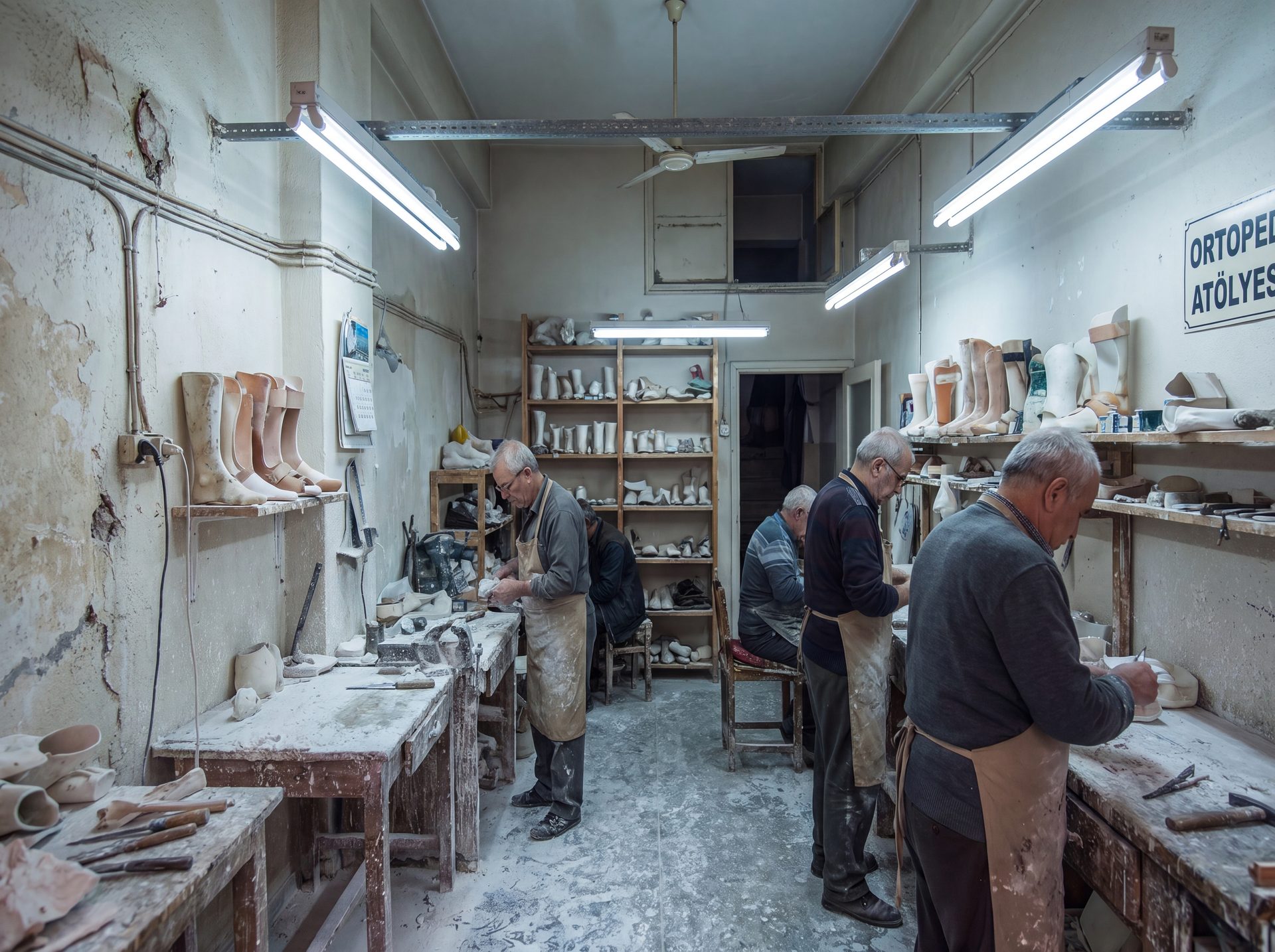
Where a phone works today is clear: digitally archiving rectified plaster positives. Scanning the models that pile up in the workshop instead of storing them makes it easier to revisit past cases, and it is a first step into a digital workflow at zero hardware cost.
For living limbs or infant heads, a fast handheld scanner is still the safer choice. If you do try a phone capture, comparing tape-measure circumferences at a few levels with the same levels on the scan is a simple but effective check. Our free residual limb volume calculator can be used for that comparison.
Clonify doesn't sell hardware and isn't tied to a scanner brand. The desktop app accepts open scan files such as PLY, STL and OBJ. The device you capture with doesn't change the measurement and design steps; it changes how trustworthy the scan itself is.
Frequently asked questions
Is a smartphone 3D scan accurate enough for orthotics and prosthetics?
On plaster casts, yes: in a 2026 study smartphone photogrammetry showed 0.89% volumetric and 0.89 mm dimensional error against a clinical scanner. On living limbs the evidence is insufficient; in a study on transtibial amputees, volumes were measured 63.4% too large and the method was judged not accurate enough for clinical use.
How do you 3D scan with a phone?
The approach that worked in studies: keep the object still, record video rather than individual photos, and place scale markers (such as ArUco) next to the object to fix scale. In the 2026 study on plaster casts, a capture took about 62 photos and 88 seconds. Clinical accuracy on living limbs has not yet been shown with this method.
Is video or photos better for smartphone scanning?
In a 2026 study on static residual limb phantoms, smartphone video achieved sub-millimetre surface accuracy and ±1% volume error, while individual still photos showed larger deviations.
Can a phone scan be uploaded to Clonify?
Yes. Clonify accepts open scan files (PLY, STL, OBJ) and is not tied to any scanner brand. The scan's accuracy depends on the capture method and on the limb staying still.
See Clonify with your own cases
Start with a free 30-minute demo.