

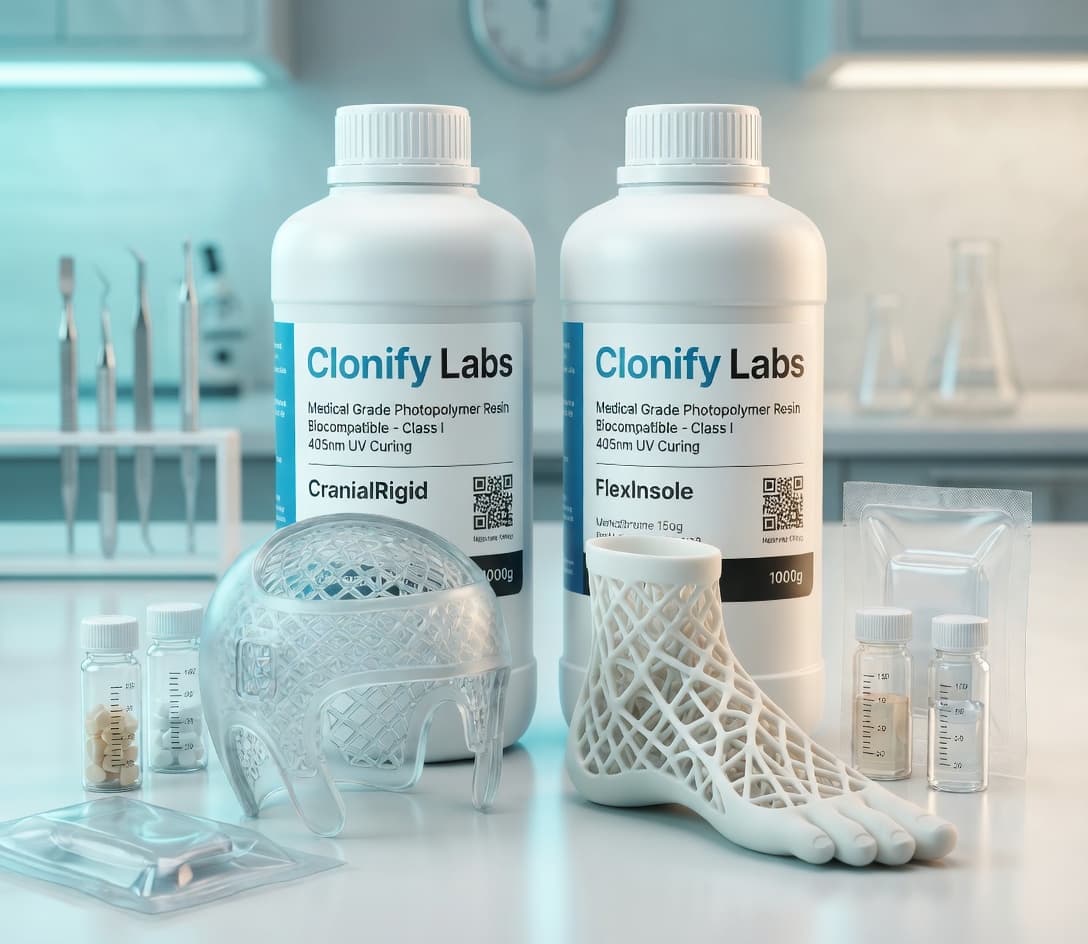
In every clinic where we start talking materials we meet the same scene: samples from three or four suppliers on the table, a comparison spreadsheet open on the screen, and justified confusion. On the datasheets they all look fine — high tensile strength, reasonable elongation, competitive price. The problem is that a datasheet describes how the material behaves as a laboratory test bar — not how the 2-millimetre-walled, curved, perforated AFO you are about to print will behave.
We do not recommend brands here. The selection logic we have settled on while working with clinics doing medical printing since our founding rests on one question: which material is right for this indication, this patient and this production line?
Indication first, chemistry second
We think about selection along three axes. The first is skin contact: does the product touch skin, and for how long? A cranial helmet is in contact with skin 23 hours a day, for months — here a biocompatibility certificate is not negotiable. A prosthetic socket usually has a liner on its inner surface; contact is indirect, but sweat and heat are present. A check socket, meanwhile, retires within days. The three do not require the same certification level, and using premium material where it is not required only inflates cost.
The second axis is the mechanical scenario. 'Make it durable' means nothing in engineering terms; resistant to fracture, to flexing, or to cyclic load? An AFO's ankle region flexes with every step — hundreds of thousands of cycles. A rigid but brittle resin is a disaster there; you need a material with high fatigue strength, or a design-material combination that flexes in the right place. In insoles it is the opposite: controlled softness and resistance to permanent deformation come first.
The third axis is the one most often forgotten: post-processing. With SLA resins, the washing and UV-curing protocol directly determines the part's final mechanical and biocompatibility properties. An under-cured 'biocompatible' resin is no longer the material its certificate promises. If the clinic lacks the infrastructure to run that protocol identically every time, the material's on-paper superiority has no counterpart in the field.
The resin-versus-filament debate
The two are tools for different jobs. SLA resin is far ahead on surface quality and fine detail — for products like helmets, where both aesthetics and inner-surface smoothness matter, it is our default choice. FDM wins on large parts, on applications that need flexibility and on cost sensitivity; TPU insoles and some AFO designs live there.
Consider a typical scenario: a clinic plans to build its insole line entirely on rigid resin, because that is the printer it owns. If the pressure distribution shows that cases needing controlled collapse in the forefoot are the majority, a flexible TPU line may be the better choice. The material should be chosen for the case population, not for the machine at hand.
Let us also touch on carbon-filled filaments, since they come up often. Yes, the stiffness-to-weight ratio is impressive. But carbon fill can weaken inter-layer adhesion, and strength varies sharply with print orientation. If you are going to use carbon in a load-bearing part, you need to have planned the print orientation around the part's force path. That knowledge is not on the datasheet; it comes with experience.
The platform's role in all this
Today Clonify covers the design part of this chain and outputs the clinician-approved design as an STL. Slicing, print profiles and material choice stay on the clinic's own production line. Indication-validated material and print-profile recommendations, along with a partner manufacturing network, are on our roadmap.
Whatever software is used, the clinical responsibility for the material decision stays with the clinic.
See Clonify with your own cases
Start with a free 30-minute demo.