

In 2011, nearly every hearing aid shell in the world was made by hand. Five years later the ratio had flipped: today a hand-made hearing aid shell is the exception. The industry abandoned the ear-impression, casting and sanding cycle for scanning and 3D printing — and it did so without anyone forcing it, simply because the economics made sense.
A similar story played out in dentistry. When intraoral scanners first appeared, the objection was that they could never match the accuracy of a conventional impression. Today it is getting hard to find a prosthetic lab that still uses impression material in its daily routine. Crowns, bridges, even orthodontic treatment planning have moved onto the digital line.
So why are orthotics and prosthetics still stuck in plaster? We have discussed this question in clinics, in congress corridors and in investor meetings ever since we founded the company. The answer is not technical but structural: O&P production is more fragmented than the dental sector, case variety is higher, and it is harder to squeeze into a single standard workflow. But those barriers are falling one by one.
Three curves are crossing at once
The first is the hardware curve. Ten years ago a clinically accurate 3D scanner sold for the price of a car and needed a dedicated technician to operate it. Today devices doing the same job cost less than a laptop; in some cases even photogrammetry data captured with a phone camera yields clinically acceptable results.
The second is the materials curve. For a long time the real obstacle to 3D printing in medical work was that no material was fit for skin contact. Resins certified for prolonged skin contact, flexible TPUs and load-bearing carbon-filled filaments are now off-the-shelf products. Today the work is choosing the right one for the device.
The third — and in our view the most critical — is the software curve. Taking scan data and aligning it, measuring asymmetry, generating the surface: until recently these were tasks that consumed hours of an experienced CAD operator's day. Advances in geometry-processing algorithms have made these steps fast and repeatable against the same reference every time. Whether the device is right for the patient is still the clinician's decision, and the production file is released only after their approval.
What does this mean in the clinic?
The numbers vary by clinic, so let us speak only from what we have. On the cranial helmet line, in two pilot clinics running in parallel with the traditional process, the clearest difference appeared at the design step: the scan-plus-guided-design flow that replaced the cast-mould-rework chain shortened the time spent on that step markedly. This is an observation limited to two clinics; it has not yet been validated in a multi-clinic protocol. The AFO and insole modules are still in development, so we publish no first-fit or revision-rate figures for those lines.
The change also shows in how the clinic works. A clinic with a plaster workshop devotes a large part of its day to fabrication. In clinics that move to the digital line, that space turns into a consultation room, and the specialist spends more of the day with patients. How many more patients the same staff and the same square metres can see is something we are measuring together with clinics; we have no published capacity multiplier.
The next five years
Making predictions is risky work, but we have the hearing aid and dental precedents in hand. In both, the transformation moved in the same order: first the early-adopter clinics captured a cost advantage, then patients noticed the difference and started asking ('the clinic next door did it without taking a cast'), and finally the rest switched under competitive pressure. In O&P we are inside the first stage; we already see signs of the second in our pilot clinics.
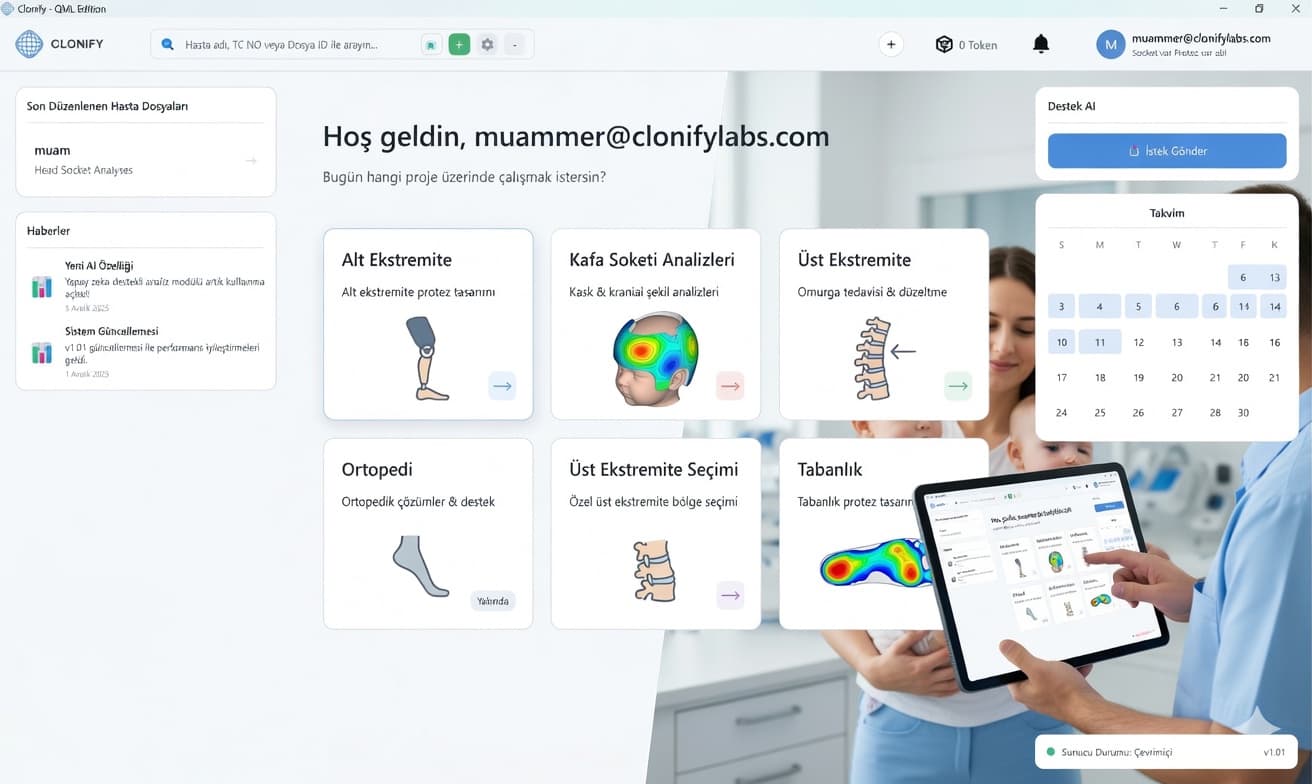
We do not expect the clinic to replace its scanner and printer. Clonify takes an open scan file (PLY/STL) and, after measurement and design, produces an STL for the clinic's existing printer. Partner manufacturing and material supply are the next steps on our roadmap.
See Clonify with your own cases
Start with a free 30-minute demo.