

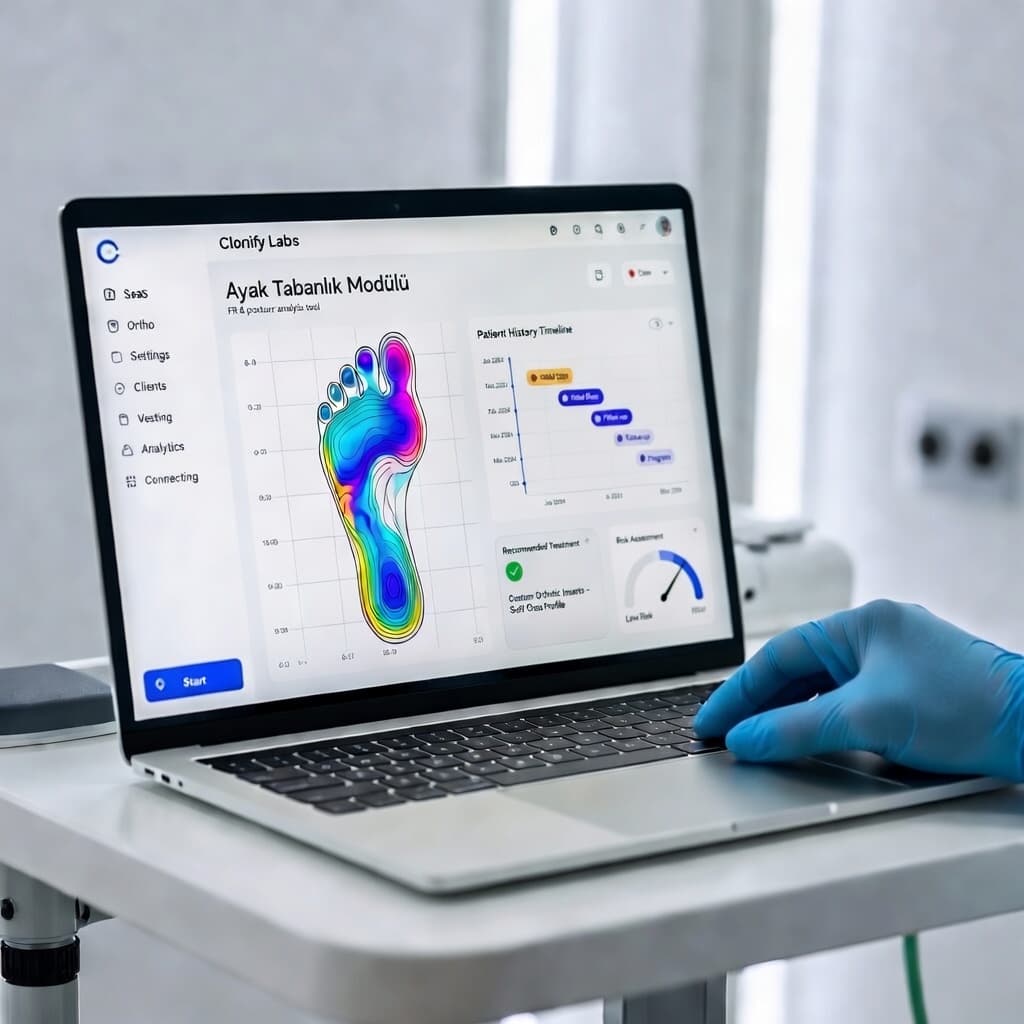
Before founding Clonify Labs and writing the first line of code, we spent months visiting clinics. In Ankara, in Istanbul, in Izmir; from large rehabilitation centres to two-person workshops. The goal was to validate a product idea, but what we actually learned was something else: the problem was never one missing tool. The clinic with a scanner had no software; the one that solved software had output that would not talk to its printer; and the rare clinics that had set up all three were employing a part-time 'format conversion specialist' to glue the systems together.
The picture was always similar: the scan in one place, the design in another, orders and patient tracking on paper or in messages. No measurement record, no approval record, no revision history. We built Clonify to close that gap.
The call: software first
From day one the idea of 'supplying everything from scanner to printer ourselves' was tempting. We deliberately did not. Clinics already buy, or will buy, scanners and printers; what is missing is the measurement, design, approval and record layer between those devices. Clonify takes an open scan file (PLY/STL) and outputs the clinician-approved design as an STL for the clinic's existing printer. Patient, report and order tracking also happen in Clonify.
For the clinic, the meaning of this decision is simple: no new hardware dependency, just software that sits on the existing line. For us it means focus: we spend limited resources not on device inventory but on measurement accuracy, design repeatability and the clinician approval flow.
Our business model follows from this: a module-based monthly software subscription. As the clinic grows it adds modules; the new modules we develop join the same subscription.
Where we stand, where we're headed
Today three lines are in the field: cranial helmet, prosthetic socket and hand splint. AFO, insole and scoliosis are in development. Scoliosis is moving slower than we planned, because clinical validation in spinal cases is more layered than in the other modules. We will not rush it; we want every module we release to have real case data behind it.
Our roadmap has four steps. First, completing the measurement protocol running in pilot clinics, publishing the results and growing the clinic network in Türkiye. Second, opening in-development modules with clinical validation. Third, a partner manufacturing network for clinics without printers: the clinic designs, an authorized centre in its region manufactures. Fourth, indication-validated material supply. After that we aim to open to regional markets with multilingual, regulation-compliant versions of the platform.
See Clonify with your own cases
Start with a free 30-minute demo.